

Airport Lounge Market Set to Soar Past US$ 45 Billion by 2035; Amid Rising Premium Travel Demand Worldwide
Global Airport Lounge Market
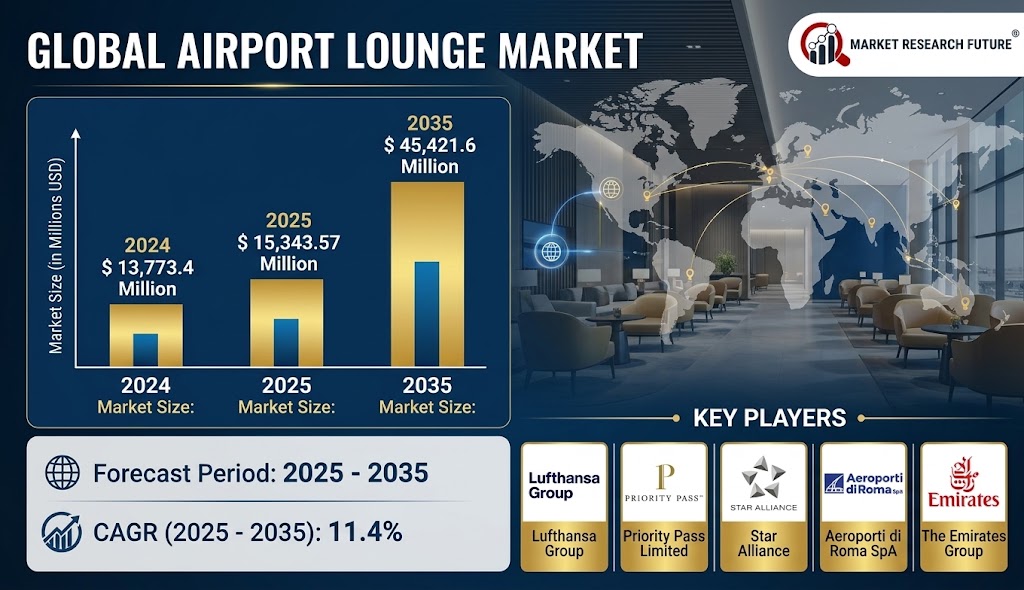
Global airport lounge market poised to expand from roughly US$ 15 billion in 2025 to over US$ 45 billion by 2035, fueled by premium travel demand.
NEW YORK, NY, UNITED STATES, August 27, 2026 /EINPresswire.com/ -- The global airport lounge market is entering a decade of substantial expansion, with valuations expected to climb from an estimated US$ 15 billion range in 2025 to well beyond US$ 45 billion by 2035. This trajectory reflects a compound annual growth rate hovering around 11.4% across the forecast window, according to recent industry analysis. The findings underscore a broader shift in how airports, airlines, and independent hospitality operators are reimagining the pre-flight experience for travelers across every class of service.Once viewed primarily as a perk reserved for first-class flyers, the airport lounge has evolved into a multifaceted business segment that now serves business travelers, frequent flyers, leisure passengers, and even budget-conscious occasional travelers who opt into pay-per-use access. This democratization of lounge access, combined with rapid airport modernization projects across emerging economies, is widely regarded as one of the defining themes shaping the market through the middle of the next decade.
A Market in Transformation:
The airport lounge sector today looks markedly different from just a few years ago. Post-pandemic recovery in global air travel has reintroduced a wave of pent-up demand for comfort, privacy, and premium amenities inside terminals that are otherwise increasingly crowded. Airlines and third-party lounge operators alike have responded by investing heavily in redesigned spaces, upgraded culinary offerings, wellness amenities such as spa treatments and shower suites, and digital check-in systems that reduce friction for travelers moving between security and their gate.
Request for Free Sample of Report: https://www.marketresearchfuture.com/sample_request/33826
Sustainability has also emerged as a defining consideration for lounge operators. Environmental regulations are tightening across major aviation hubs, and many lounge networks are responding by partnering with low-emission ground transportation providers, reducing single-use packaging, and adopting digital ticketing to cut down on paper waste. These initiatives are increasingly viewed not as optional add-ons but as core components of long-term brand strategy, particularly as corporate travelers and their employers place greater emphasis on environmentally conscious travel partners.
Meanwhile, the rise of independent, multi-airport lounge operators has introduced a new layer of competitive dynamics. These operators offer airlines a way to provide consistent, branded lounge experiences across multiple airports without carrying the capital and staffing costs of building and running proprietary spaces. This model has proven especially attractive to mid-sized carriers and alliances looking to extend premium services into secondary markets without the overhead traditionally associated with lounge ownership.
Segment-Level Momentum:
The market's segmentation reveals where growth is concentrating and where it is accelerating fastest.
By travel class, the Economy and Premium Economy category currently commands the largest share of the market, reflecting the sheer volume of travelers in these cabins and the growing willingness of carriers to extend limited lounge perks to non-premium passengers through paid upgrades or loyalty tiers. Business Class, however, is emerging as the fastest-growing category, as airlines double down on differentiating the business travel experience with dedicated spaces offering quiet work areas, curated dining, and faster boarding coordination.
By access type, Membership Access remains the dominant channel, anchored by well-established programs that grant travelers entry to a network of lounges regardless of the airline they are flying. At the same time, Airline Ticket Access is expanding at the quickest pace, as more carriers bundle lounge privileges directly into premium fare classes and elite loyalty tiers to strengthen customer retention.
By application, Regular Travelers represent the largest user base, followed closely by a fast-growing segment of Frequent Travelers who increasingly view lounge access as a baseline expectation rather than a luxury. Occasional Travelers, while smaller in share, are becoming an important target for pay-per-use models that lower the barrier to entry.
By airport type, International terminals continue to generate the bulk of lounge revenue, given the longer dwell times and higher concentration of premium and business travelers passing through these hubs. Domestic lounges, however, are catching up quickly as regional carriers and airports in fast-growing economies build out amenities to match rising expectations among local flyers.
By end user, Leisure Travelers currently make up the largest cohort by volume, a reflection of the sheer scale of vacation and personal travel worldwide. Business Travelers, though smaller in absolute numbers, are the fastest-growing end-user group, driven by corporate travels budgets that increasingly prioritize comfort and productivity during transit.
By provider type, Third-Party Companies hold the largest share of the market today, offering flexible, brand-agnostic lounge networks that appeal to a wide range of airlines and travelers. Airline-operated lounges, meanwhile, are growing at a faster clip as carriers reinvest in flagship spaces to reinforce brand loyalty among their highest-value customers.
Regional Outlook:
Regionally, the competitive and growth picture varies considerably.
North America continues to see steady expansion, propelled by rising disposable incomes, an increase in frequent flyer program enrollment, and the continued broadening of membership-based lounge access to a wider swath of travelers. Operators in the region are prioritizing technology integration and sustainability commitments as differentiators in an increasingly crowded field.
Europe remains home to some of the busiest and most storied aviation hubs in the world, including major gateways in London, Paris, Amsterdam, and Frankfurt. The region's lounge market benefits from a diverse mix of airline-branded spaces and independent operators offering everything from gourmet dining to dedicated business facilities.
Asia-Pacific stands out as the fastest-growing region globally, a trend driven by rapidly expanding middle-class populations, rising air travel penetration, and major hub airports in Hong Kong, Singapore, and Tokyo investing heavily in premium terminal experiences. Membership-based access models have played a particularly important role in extending lounge availability to a broader traveler base across the region.
South America is expanding at a more gradual pace, with international gateways in São Paulo, Bogotá, and Buenos Aires emerging as focal points for premium lounge investment as both regional and international carriers seek to capture growing demand for comfort among long-haul passengers.
The Middle East and Africa region is experiencing some of the most rapid growth worldwide, underpinned by the strategic position of hubs such as Dubai, Abu Dhabi, and Doha as connecting points between Europe, Asia, and Africa. Flagship lounges operated by major regional carriers continue to set a high bar for luxury amenities, from fine dining to dedicated business zones.
Competitive Landscape:
The airport lounge market remains highly fragmented and competitive, with global airline groups, alliance networks, membership program operators, and independent lounge companies all vying for traveler loyalty. Prominent names shaping the competitive landscape include Lufthansa Group, Priority Pass Limited, Star Alliance, Aeroporti di Roma SpA, The Emirates Group, and Etihad Airways, alongside additional major participants such as American Airlines, United Airlines, TAV Operation Services, Manchester Airport Group, Virgin Australia, Marhaba Lounge Melbourne, and No.1 Lounges, operated by Swissport. Independent networks and card-linked lounge collections have also carved out a significant presence, broadening access for cardholders and members beyond traditional airline-specific offerings.
Competition among these players is being shaped by several forces at once: rapid technological change, shifting government regulations around aviation and hospitality services, and mounting pressure to meet evolving environmental standards. Operators that can combine cost efficiency with consistently high service quality are best positioned to gain share in a market where traveler expectations continue to climb.
Credit-card-linked lounge collections have also become an important competitive force, extending premium access to cardholders who may not otherwise qualify through airline status or membership tiers. This has widened the addressable customer base considerably, drawing in a segment of affluent travelers who value lounge access as a standalone benefit rather than a byproduct of frequent flying. Similarly, global airline alliances have used shared lounge agreements as a way to offer reciprocal access across member carriers, giving travelers a more consistent premium experience even when connecting between different airlines on a single itinerary.
At the same time, smaller regional and boutique lounge operators are carving out niches by focusing on hyper-localized amenities, from regional cuisine to culturally distinct design themes, giving travelers a differentiated experience compared to the more standardized offerings of larger global chains. This blend of scale players and specialized operators is expected to keep the competitive landscape dynamic well into the next decade, with consolidation activity likely as larger groups look to acquire niche networks to round out their regional coverage.
Recent developments illustrate the pace of change. Lufthansa Group opened an expanded premium lounge in Newark, New Jersey, in 2025, increasing guest capacity by roughly a quarter compared to its previous space and extending access to first and business class passengers as well as top-tier loyalty members. Around the same time, Priority Pass adjusted its airline lounge partnerships, removing a small number of properties from its network amid shifting airport-level agreements. Star Alliance also marked a notable milestone by opening its first lounge in Asia, located at Guangzhou Baiyun International Airport, extending premium access to first and business class travelers as well as top-tier alliance status holders on departing flights.
Growth Drivers and Opportunities:
Two forces stand out as the primary engines behind the market's projected expansion through 2035.
The first is the continued surge in global air travel demand. Passenger volumes have climbed steadily as travel recovers and grows beyond pre-pandemic levels, with load factors on many routes reaching multi-decade highs. This has placed sustained pressure on airports to expand amenities capable of accommodating fuller flights and busier terminals, with lounges emerging as a key release valve for congestion and a way to enhance the overall passenger experience.
The second driver is the ongoing expansion and modernization of airport infrastructure itself. As airports across both developed and emerging markets undertake terminal expansions to keep pace with rising traffic, lounge development has become a natural complement to broader renovation and construction efforts, particularly in fast-growing economies where air travel is becoming more accessible to a wider population.
Looking ahead, industry observers point to several areas of opportunity that could shape the next phase of growth. Expansion into emerging markets remains a significant avenue, as air travel adoption continues to rise in regions that have historically lagged behind in premium terminal amenities. The continued growth of independent lounge networks offers another path forward, giving airlines a capital-light way to extend premium services without the burden of direct ownership. Finally, digital transformation and the rise of smart lounge experiences, including AI-driven personalization and contactless service technologies, are expected to play an increasingly central role in how operators differentiate themselves and retain traveler loyalty.
Beyond these headline opportunities, operators are also exploring hybrid revenue models that combine subscription-style membership fees with a la carte upgrades, such as premium dining packages or private meeting rooms, allowing lounges to capture additional spend from travelers who might otherwise view a flat-rate membership as sufficient. Partnerships with hospitality and wellness brands are becoming more common as well, with some lounges now offering branded spa treatments, curated retail pop-ups, and even short-stay rest pods for travelers on long layovers. These ancillary revenue streams are increasingly viewed as essential to offsetting the rising real-estate and staffing costs associated with operating premium spaces inside high-traffic terminals.
Workforce considerations are also shaping strategic planning across the industry. As lounges become more service-intensive, with expectations around personalized greetings, curated food and beverage programs, and concierge-style assistance, operators are investing more heavily in staff training and retention. This is particularly true in regions experiencing rapid lounge network expansion, where the availability of skilled hospitality talent can act as a constraint on how quickly new locations can be brought online.
Looking Toward 2035:
Taken together, these trends point to an airport lounge industry that is not only growing in scale but also diversifying in how it serves travelers. What was once a narrow, exclusivity-driven niche has broadened into a segmented ecosystem spanning multiple traveler types, access models, and provider structures. As airports continue to modernize and air travel demand shows no signs of slowing, stakeholders across the value chain, from global airline alliances to independent lounge operators and airport authorities, are likely to find expanding opportunities to invest in and shape the next decade of premium travel experiences.
Industry participants, investors, and airport authorities evaluating opportunities in this space are encouraged to monitor regional infrastructure investment, evolving loyalty program structures, and the continued expansion of third-party lounge networks as key indicators of where the market is headed next.
Browse More Reports:
Airport Baggage Screening Systems Market
https://www.marketresearchfuture.com/reports/airport-baggage-screening-systems-market-4132
Airport Full Body Scanner Market
https://www.marketresearchfuture.com/reports/airport-full-body-scanner-market-23750
Airport Sleeping Pods Market
https://www.marketresearchfuture.com/reports/airport-sleeping-pods-market-6028
Market Research Future
Market Research Future
+1 855-661-4441
sales@marketresearchfuture.com
Legal Disclaimer:
EIN Presswire provides this news content "as is" without warranty of any kind. We do not accept any responsibility or liability for the accuracy, content, images, videos, licenses, completeness, legality, or reliability of the information contained in this article. If you have any complaints or copyright issues related to this article, kindly contact the author above.
